
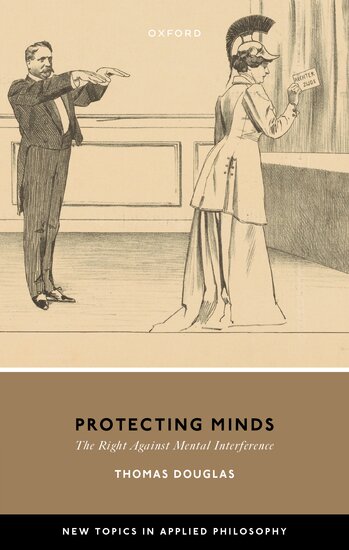
If your doctor injects you with a vaccine without your consent, or a stranger strokes the back of your neck on a packed train, we would think that they have wronged you, morally speaking. And we might capture this wrong by saying that they have trespassed on your body or infringed your right against bodily interference. By contrast, if a computer game designer uses loot boxes to boost your desire to keep playing a game, or a video platform uses subliminal imagery to create positive associations with particular products, we would probably not be inclined to reach for the concepts ‘mental interference’ or ‘mental trespass’. But perhaps we should. In my just-published book, Protecting Minds, I argue that, just as we all possess a moral right against interference with our bodies, so too we possess a right against mental interference. I also offer an account of the scope of the right—of the forms of mental influence that infringe it—and, on my account, loot boxes and subliminal imagery likely fall within this scope.
The book is an output of my European Research Council-funded project ‘ProtMind’ [grant number 819757], and thanks to that funding, the book is available to read gratis online. If you’re interested in the ethics of nudging, manipulation, persuasive digital technologies, or other forms of influence on others’ minds and behaviour, please take a look!
A useful example perhaps offering further material to the meaning of an extended mind would be an individuals shared diary in the workplace where other individuals have rights to alter the diary contents, perhaps limited to say something simple like times for meetings. Provided all of that workplace social group works solely in the interests of the whole group, rather than individual interests, this would not present problems. But if particular individuals or cohorts work in their own interests, within the social group, based on a view their interests are better for the social group than any widely agreed interests of all other members, any alterations they make would in a final analysis be determined by the furtherence of their own interests, and those alterations may not accord with the diary owners interests. Such ill considered alterations would ostensibly fall under the extended RAMI, but other alterations would not. Examples like that cause to illustrate an extended RAMI of the individual within a social group being disturbed by other members of the group. But allowing that the example allows for social groups interests to also be subverted by an individual or smaller group within it, would the RAMI of the individual be wronged, or the agreed social rules of the whole social group, and if both, would there be different rules and priorities applied to the wrongs caused to the individuals’ RAMI and the social groups structured rules?
Within the book the presented arguments appear to strongly conflate the social group within the individual. The apparent confusion is probably a direct result of the RAMI conceptually extending as it must across many socially available digital inclusions within individual space, which are currently widely used to directly interfere with the individual. Those who choose to further their own interests by control of individuals via those mechanisms will no doubt present much resistence to an extended RAMI, which these days because of the pressures on every individuals’ space may also be delivered in a bellicose manner.