
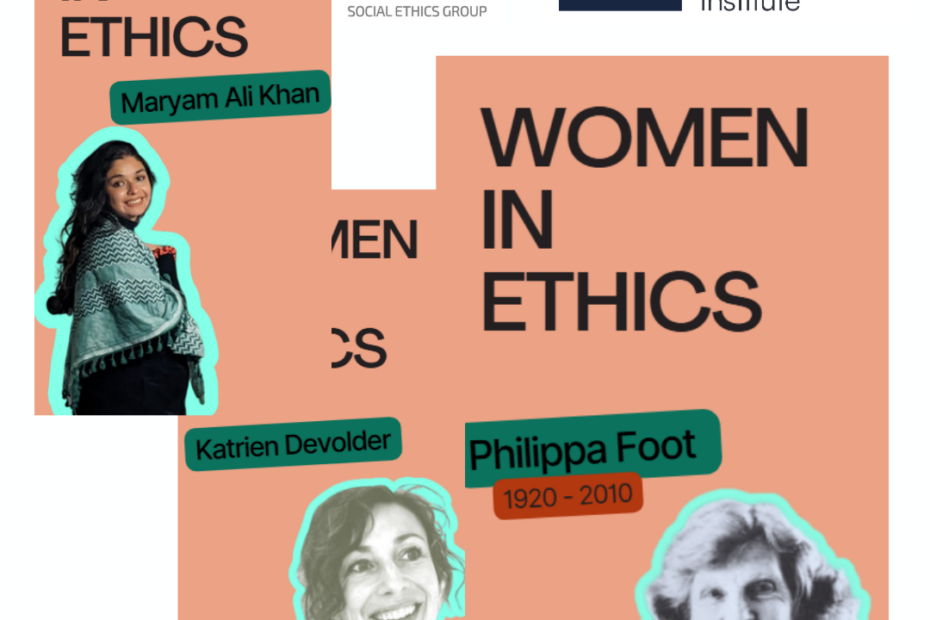
The academic study of ethics is full of ideas that shape how we think about the world, and many of them come from women whose work deserves to be better known. Women writers, thinkers and ethicists have contributed for millennia alongside their male counterparts, yet their work has been often forgotten or side-lined.
In our new series of reels #WomeninEthics, a collaboration between the Department of Social Ethics at the University of Bonn and the Uehiro Oxford Institute at the University of Oxford, we’re shining a light on women thinkers and the ideas they’ve brought to the field.
Our first featured thinker, Philippa Foot, was an Oxford-based philosopher and ethicist, who created the trolley problem – used in classrooms, ethics committees, even memes – but hardly anyone knows it was created by a woman.
In this series, we’ll be introducing you to brilliant women in ethics like her, past and present, whose ideas deserve to be known.
We’d love to hear from you if you have ideas about women we should feature in the series (tell us in the comments section below), and you can catch up on all the reels on our YouTube channel and Instagram page.
#WiE. More remarkable women, every Thursday on Instagram.
Stay curious.
#womeninethics #WiE #PhilosophyMatters #ethicsinfocus #thinkerstoknow
I think three contemporary philosophers are worthy of being featured in this web series.
1. Janet Radcliffe Richards, who has made important contributions to feminist thought and the ethics of organ donation.
2. Heidi Mertes, who has made contributions in social egg freezing and the relative importance of genetic parenthood.
3. Holly Lawford-Smith: Her recent work surrounding gender critical feminism may be controversial in some circles, but I suspect her work closely mirrors the criteria for who is eligible to be featured in this series. If not, it may be useful to include someone whom Lawford-Smith would exclude from being featured in the WIE series.
Thanks for your consideration.
Jesses
Thanks Jesse! Great suggestions.
This is a wonderful and much-needed initiative
Highlighting women like Philippa Foot and the origins of influential ideas such as the trolley problem helps correct the historical imbalance in how intellectual contributions are recognized.
Using short-form reels to introduce complex ethical thinkers is also a great example of how educational content can reach wider, younger audiences through social media. Visual storytelling makes philosophy and ethics feel more accessible and engaging.
For anyone interested in creating similar educational reels or short videos, simple tools and beginner-friendly templates can really help streamline the process:
https://capcuttemplatex.com/
If we consider this place as a platform for women, I have no say. But if we regard it as a platform for voicing grievances, then I have something to say.
The current system not only suppresses women, but also hinders innovation. The “perfect paper” system is a serious suppression of innovation. Because “innovation” often has flaws and is not “perfect”, it cannot be accepted by the demanding system. Therefore, some have proposed a “proposal for the reform of doctoral education”:(The website is unable to upload. Those who want to view it can search for it themselves.)
Comments are closed.