
By Taka Kurogi, Bruno dos Santos Queiroz
We were pleased to be welcomed at the Bentham Project by Drs. Isra Black and Tim Causer of UCL’s Faculty of Laws. It was deeply inspiring to learn more about the Project’s ongoing work and its central role in preserving, studying, and, most importantly, making publicly accessible the writings of Jeremy Bentham, whom we also had the great pleasure of “meeting” there.
Born on February 15, 1748, Bentham was a philosopher who has been and will always be associated with the doctrine of utilitarianism, which is often summarized by the catchphrase, “the greatest good for the greatest number.” In An Introduction to the Principles of Morals and Legislation (1789), he lays out his foundational premise as follows:
“Nature has placed mankind under the governance of two sovereign masters, pain and pleasure. It is for them alone to point out what we ought to do, as well as to determine what we shall do.”
According to Bentham, an action is thus right if and only if it maximizes utility, that is, the balance of pleasure over pain. This revolutionary idea, grounding morality in sentience, has had a profound influence on modern ethics, including the rise of animal ethics.
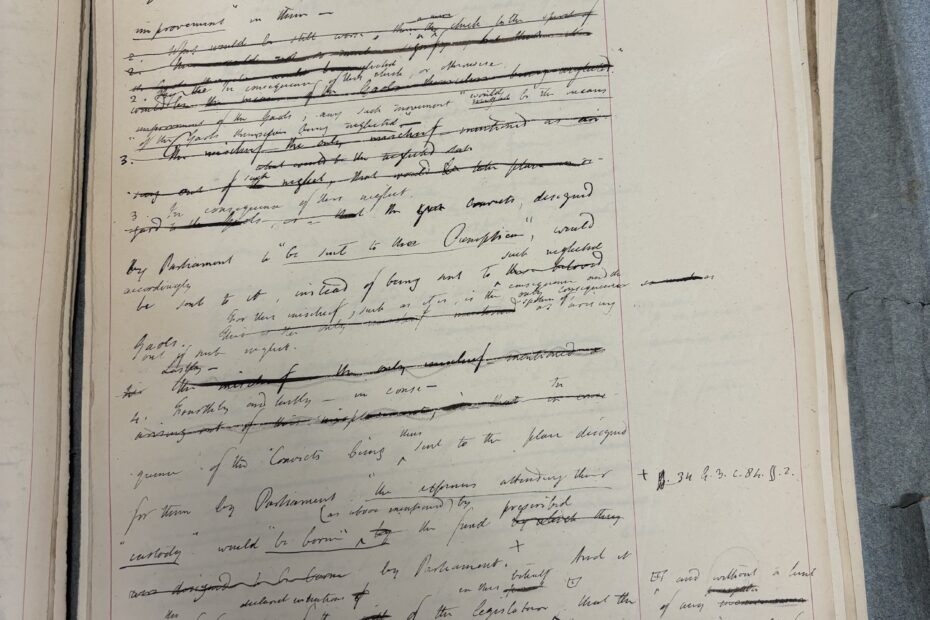
The highlight of our visit was the chance to see Bentham’s manuscripts in their original physical form. As admirers of Bentham, standing in front of something he wrote over two centuries ago, covered in dense revisions, was a true revelation for us.
We are very grateful to Drs. Black and Causer for their warm welcome, and to Dr. Lisa Forsberg for putting us in touch.
—
For those interested in exploring Bentham’s central thought, we recommend the following:
- Crimmins, J. E. (2015). Jeremy Bentham. Stanford Encyclopedia of Philosophy. https://plato.stanford.edu/entries/bentham/
- Bentham, J. (1789/1996). An introduction to the principles of morals and legislation (J. H. Burns and H. L. A. Hart, Eds.). Oxford University Press.
The Bentham Project has digitalized Bentham’s manuscripts, which are accessible online.
The Bentham Project has also edited and published 37 volumes of The Collected Works of Jeremy Bentham and 13 volumes of The Correspondence of Jeremy Bentham, short summaries of which are available to the public.
For a discussion of how Bentham’s ideas contributed to the rise of animal ethics, we recommend Chapter 1 of Peter Singer’s Animal Liberation Now (2023).
—
P.S. With Bentham’s birthday (February 15) just around the corner, it felt like a particularly appropriate time to share reflections on our visit.