Skip to content

admin

Guest Post: Nothing if not family?

  • by

Written by Daniela Cutas Lund University

What are genetic relatives to each other if they are not de facto relatives? Is there no relation between a donor-conceived person and their gamete donor? Between the donor-conceived person and the donor´s other offspring or parents or aunts and uncles? Should parents facilitate acquaintance between their children and their children´s gamete donors or donor siblings or other close genetic relatives?

Answers to these questions will differ depending on how one regards the significance of genetic ties. For some, genetic ties equal real relatedness between people: blood is thicker than water, and your genetic relatives ultimately are your family. Anything else is at best a proxy, and at worst a lie. For others, the focus on genes and genetic relatedness is irrational and potentially harmful. It reinforces prejudice and reduces people to their biological components and the relationships between them to combinations of genes. Both these and other attitudes are simultaneously represented in many cultures and legislatures in the Western world. Sometimes, parents of donor-conceived children, who see themselves without a doubt as their children´s rightful parents, may fear that their children may choose to see the gamete donors as their parents instead. Other parents and children may be blissfully in sync with each other but find themselves in extended families and communities in which others see things differently and behave accordingly.Read More »Guest Post: Nothing if not family?

Guest Post: High Risk, Low Reward: A Challenge to the Astronomical Value of Existential Risk Mitigation

Written by David Thorstad , Global Priorities Institute, Junior Research Fellow, Kellogg College

This post is based on my paper “High risk, low reward: A challenge to the astronomical value of existential risk mitigation,” forthcoming in Philosophy and Public Affairs. The full paper is available here and I have also written a blog series about this paper here.

Derek Parfit (1984) asks us to compare two scenarios. In the first, a war kills 99% of all living humans. This would be a great catastrophe – far beyond anything humanity has ever experienced. But human civilization could, and likely would, be rebuilt.

In the second scenario, a war kills 100% of all living humans. This, Parfit urges, would be a far greater catastrophe, for in this scenario the entire human civilization would cease to exist. The world would perhaps never again know science, art, mathematics or philosophy. Our projects would be forever incomplete, and our cities ground to dust. Humanity would never settle the stars. The untold multitudes of descendants we could have left behind would instead never be born.Read More »Guest Post: High Risk, Low Reward: A Challenge to the Astronomical Value of Existential Risk Mitigation

Video Interview: Introducing Academic Visitor Dr María de Jesús Medina Arellano

  • by

An interview with academic visitor Dr María de Jesús Medina Arellano, Professor and Researcher at the Institute of Legal Research at the National Autonomous University (UNAM), on her research focusing on the ethics and regulation of biotechnologies in developing countries, such as stem cell science, human genome editing and reproductive technologies.

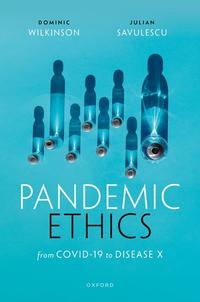
Book Launch: Pandemic Ethics: From Covid-19 to Disease X

  • by

Press release and an interview with Prof Dominic Wilkinson on the new book, Pandemic Ethics: From Covid-19 to Disease X, which he has co-authored with Prof Julian Savulescu.

Press Release: Are we ethically prepared for Disease X?


image of pandemic ethics book cover
Oxford University Press

1 May 2023

According to some estimates, there is more than a one in four chance in the next decade of another global pandemic. We don’t know whether this will be influenza, a coronavirus (like SARS and COVID), or something completely new. The World Health Organisation refers to this unknown future threat as “Disease X”.Read More »Book Launch: Pandemic Ethics: From Covid-19 to Disease X

Cross Post: Dutch Government to Expand Euthanasia Law to Include Children Aged One to 12 – An Ethicist’s View

  • by

Written by Dominic Wilkinson, University of Oxford

Ernst Kuipers, the Dutch health minister, recently announced that regulations were being modified to allow doctors to actively end the lives of children aged one to 12 years who were terminally ill and suffering unbearably.

Previously, assisted dying was an option in the Netherlands in rare cases in younger children (under one year) and in some older teenagers who requested voluntary euthanasia. Until now, Belgium was the only country in the world to allow assisted dying in children under 12.

Under the proposal, it will remain against the law for doctors in the Netherlands to actively end the life of a child under the age of 12. However, a force majeure clause gives prosecutors the discretion not to prosecute in exceptional circumstances.

In 2005, Dutch doctors and legal experts published guidelines (the so-called “Groningen protocol”) elaborating when these exceptional circumstances would apply for infants under the age of one year. That included certainty about diagnosis and prognosis, “hopeless and unbearable suffering”, the support of both parents and appropriateness confirmed by an independent doctor.

The new regulations would allow the same principles to apply to children between one and 12 years of age.Read More »Cross Post: Dutch Government to Expand Euthanasia Law to Include Children Aged One to 12 – An Ethicist’s View

Oxford Uehiro Prize in Practical Ethics: Turning up the Hedonic Treadmill: Is It Morally Impermissible for Parents to Give Their Children a Luxurious Standard of Living?

This essay was the overall winner in the Undergraduate Category of the 2023 National Oxford Uehiro Prize in Practical Ethics

Written by University of Oxford student, Lukas Joosten

Most parents think they are helping their children when they give them a very high standard of life. This essay argues that giving luxuries to your children can, in fact, be morally impermissible. The core of my argument is that when parents give their children a luxurious standard of life, they foist an expectation for a higher standard of living upon their children, reducing their lifetime wellbeing if they cannot afford this standard in adulthood.

I argue for this conclusion in four steps. Firstly, I discuss how one can harm someone by changing their preferences. Secondly, I develop a model for the general permissibility of gift giving in the context of adaptive preferences. Thirdly, I apply this to the case of parental giving, arguing it is uniquely problematic. Lastly, I respond to a series of objections to the main argument.  Read More »Oxford Uehiro Prize in Practical Ethics: Turning up the Hedonic Treadmill: Is It Morally Impermissible for Parents to Give Their Children a Luxurious Standard of Living?