Skip to content

Ethics

Nudge Drugs: should the social side-effects of medications weigh into public health?

You are a public health official responsible for the purchasing of medications for the hospitals within your catchment area in the NHS. Your policies significantly affect which, out of the serpentine lists of heart disease medications, for example, are available to your patients. Today, you must choose between purchasing one of three heart disease medications: Drug A, Drug B, and Drug C. They are pretty similar in efficacy, and all three have been being used for many years. Drug B is slightly less expensive than Drug A and Drug C, but there is emerging evidence that it increases the likelihood that patients will take “bad bets,” i.e. make large gambles when the chance of winning is low (and thus might contribute to large social costs). Drug C costs a tiny bit more than Drug A, but there is some evidence that Drug C may help decrease implicit racial bias. You have been briefed on the research suggesting that implicit racial bias can lead to people making choices that consistently and unintentionally limit the opportunities of certain groups, even when all the involved parties show explicit commitments to social equality.  Finally, there is emerging evidence that drug A both helps people abstain from alcohol and dissociates negative emotional content from memories.

Which drug should you purchase?


Let us begin to think about this question through the lens of the idea of the “Nudge,” which has exploded onto the public sphere (and blogosphere) since Thaler and Sunstein’s published their book, “Nudge: improving decisions about health, wealth, and happiness.”   (see the blog here). I briefly and incompletely introduce nudges here, in hopes that we may soon move on to discuss the kind of “nudge drugs” our thought experiment considers.

Read More »Nudge Drugs: should the social side-effects of medications weigh into public health?
Unbelievers are bad and have defective brains

By Charles Foster

You’d better believe that believers are better.

So far as religiosity is concerned, humanity, say Cooper and Pullig , is divided fairly neatly into three clusters: Skeptics, Nominals and Devouts. The bulk of the evidence suggests that there is a relationship between religiousness and moral reasoning. That relationship, though, is complex. Its anatomy needs a lot of exploration. Cooper’s and Pullig’s exciting and audacious paper, which concerns broadly Christian religiosity amongst marketing students in the US, suggests that narcissism is a factor in explaining why individuals make wrong ethical decisions. That in itself isn’t surprising. Narcissism, for instance, is a predictor of white-collar crime in business: narcissistic individuals tend to think that they are above the laws that govern the behaviour of lesser mortals. What is perhaps surprising is that ethical decision-making was affected by narcissism only in Nominals and Devouts. The reasons for that can be speculated about very entertainingly. But I want to highlight one almost incidental observation: ‘Notably, Skeptics in general exhibit worse ethical judgment than respondents in either of the other two clusters.’

Read More »Unbelievers are bad and have defective brains

The will is caused, not free

By Brian Earp

See Brian’s most recent previous post by clicking here.

See all of Brian’s previous posts by clicking here.

Follow Brian on Twitter by clicking here.


The will is caused, not free

Everyone is talking about free will these days. Sam Harris has a new book out. Eric MacDonald has weighed in on that. Jerry Coyne, Paul Bloom, and some philosopher-types have a debate going on in the Chronicle of Higher Education. And way back in 2009 the Society for Personality and Social Psychology hosted a “showdown” between psychologists Roy Baumeister and John Bargh on the topic: What does the ‘free’ in ‘free will’ really mean? [A video of Bargh’s half can be seen here. Baumeister is here.]

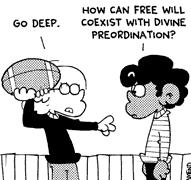
The SPSP conference led to a fiery exchange of blog posts between the two principles, and then to a more sedated pair of papers in the society’s newsletter, Dialogue. Baumeister enlisted Kathleen Vohs to co-author his piece, and Bargh (for some reason) enlisted me. Here is what Professor Bargh and I had to say — after this delightful FoxTrot comic by Bill Amend.

Read More »The will is caused, not free

Kony 2012 and Saying What You Mean

Kony 2012 has become the highest profile issue of international justice on social media by far. For those without a Facebook account, Kony 2012 is a slick 30-minute YouTube film about Joseph Kony, leader of the Lords Resistance Army. The video explicitly seeks to mobilise support for efforts to arrest Kony, who has been indicted by the International Criminal Court for crimes against humanity, particularly against children. As I type, the video, released Monday, is approaching 70 million views. The video has also attracted a fair share of criticism, much of which I’m not sure is honest.

Read More »Kony 2012 and Saying What You Mean

Moormann

Arbitrary Execution: Why the Law Needs Help from Neuroscience, Psychology and Philosophy

On February 29th, 2012, Robert Henry Moormann was executed in Arizona for murder. Back in 1984, he was in prison for kidnapping and molesting an eight year old girl, when the state gave him three days of compassionate leave. His elderly adoptive mother took a long bus trip to go and meet him. After an argument in a motel room where she was staying, he beat, stabbed and suffocated her, then dismembered her body. He asked a number of local businesses if he could dispose of “spoiled meat and animal guts” in their refuse containers, before disposing of most of her remains in bins and sewers around town. He also asked a prisoner officer to dispose of a box of what he described as “dog bones”. This behaviour raised suspicion. Moormann claimed not to remember the details of the crime, and at the original trial, Moormann’s lawyers mounted a defence of insanity. The jury rejected it. Since 1985, he had been living on death row while his appeals process was gradually exhausted.

In light of the gruesomeness of his crime, it is easy to think that if anyone ever deserved the death penalty, Moormann did. But the contention of Moormann’s defence lawyers that he was intellectually disabled casts a new light on the case.

Read More »Arbitrary Execution: Why the Law Needs Help from Neuroscience, Psychology and Philosophy

ASSASSINATING CITIZENS: How not to fight terror

By Brian Earp

See Brian’s most recent previous post by clicking here.

See all of Brian’s previous posts by clicking here.


In this ‘hour’ of danger: Civil liberties and the eternal threat of terror

NBC’s Pete Williams reports:

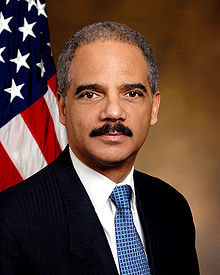
The U.S. government is legally justified in killing its own citizens overseas if they are involved in plotting terror attacks against America, Attorney General Eric Holder said Monday.

“In this hour of danger, we simply cannot afford to wait until deadly plans are carried out, and we will not,” he said in remarks prepared for a speech at Northwestern University’s law school in Chicago.

Pay attention to Mr. Holder’s choice of words here. This hour of danger? Excuse me: an “hour” is a bounded stretch of time – and not very long. But terrorism is a threat with no border – it has existed always, and will continue indefinitely. The “war on terror” cannot be won: you can kill a terrorist, sure, but you cannot eliminate a tactic. So let us not talk about an “hour.” This sort of speech is insidious. We all know that an hour takes sixty minutes and then it’s finished. But terrorism will present a “danger” forever.

Read More »ASSASSINATING CITIZENS: How not to fight terror

The censor and the eavesdropper: the link between censorship and surveillance

Cory Doctorow makes a simple but important point in the Guardian: censorship today is inseparable from surveillance. In modern media preventing people from seeing proscribed information requires systems that monitor their activity. To implement copyright-protecting censorship in the UK systems must be in place to track where people seek to access and compare it to a denial list, in whatever medium is used.

Read More »The censor and the eavesdropper: the link between censorship and surveillance

Rick Santorum, birth control, and “playing God”

By Brian Earp

See Brian’s most recent previous post by clicking here.

See all of Brian’s previous posts by clicking here.

Follow Brian on Twitter by clicking here.

Rick Santorum, birth control, and “playing God”

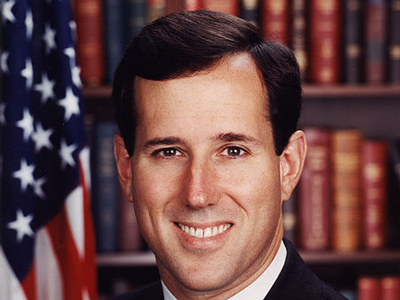
Rick Santorum thinks that birth control is immoral. Santorum, a former Senator from Pennsylvania, is one of two human beings – if the polls have it right – likeliest to become the Republication nominee for President of the United States this election cycle.

Read More »Rick Santorum, birth control, and “playing God”