
-
Robot Girl: A Survey
In collaboration with the BBC’s Radio 4 show ‘The Philosopher’s Arms‘, we are running a series of short opinion surveys on the Practical Ethics blog as a way of promoting discussion on issues in practical ethics. This week The Philosopher’s Arms discussed the case of the Robot Girl, in which we consider the ethical problems…
-
Why Pro-Life Counsellors Ought to Lie
Those who are pro-choice often get frustrated by anti-abortion advocates, who are seen as using underhanded and immoral tactics to decrease numbers of abortions. These include presenting misleading information about abortions at their advice centres. For example, it is claimed that some abortion counsellors show pictures of late-stage abortions when discussing early-stage abortions, exaggerate the trauma felt by…
-
The Experience Machine: A Survey
In collaboration with the BBC’s Radio 4 show ‘The Philosopher’s Arms‘, we are running a series of short opinion surveys on the Practical Ethics blog as a way of promoting discussion on issues in practical ethics. This week The Philosopher’s Arms discussed the problem of the Experience Machine, Robert Nozick’s hypothetical scenario about the machine…
-
Geoengineering, Science, Consequentialism and Humility
The Uehiro Centre has recently hosted Clive Hamilton who was visiting from the Centre for Applied Philosophy and Public Ethics at Charles Sturt University. Hamilton is well known for his work on the politics of climate change. While here he presented a paper on the ‘Ethical Foundations of Climate Engineering’, which he has now been…
-
Unpalatable Theories about Falling Crime
The US crime rate continues to fall. There is no consensus why this is so, but there are a range of diverse theories, ranging from gun control, higher incarceration rates, the collapse of the crack cocaine epidemic, and ‘zero tolerance’ policing. While the diverse theories are interesting, so too are the different reactions that the…
-
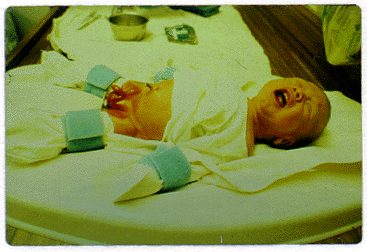
Is the non-therapeutic circumcision of infant boys morally permissible?
On the ethics of non-therapeutic circumcision of minors, with a pre-script on the law By Brian D. Earp (Follow Brian on Twitter by clicking here.) PRE-SCRIPT AS OF 25 SEPTEMBER 2012: The following blog post includes material from an informal article I wrote many years ago, in high school, in fact, for a college essay competition.…
-
Evidence on Evidence Based Policy
You were no doubt as surprised as I was when the Blair government announced it was henceforth doing evidence based policy. It was just like when the medical profession said it was going to do evidence based medicine. You mean—they weren’t already? Still, even though the promised reform doesn’t really sweeten the bitter truth, it…
-
Is Half an Abortion Worse than a Whole One?
Last week, the New York Times Magazine included an interesting article about abortion by Ruth Padawer. It provoked not a little angst and soul-searching among members of the pro-choice community, as well as some exultant pronouncements from anti-abortionists highlighting supposed inconsistencies in the pro-choice position. The Times article profiled a number of women who chose…
-
Philosophy is the transformation of sheep
What’s the philosopher’s job? In this and all other cases it is simple to describe, and desperately difficult to do: it is (by pointing out the importance of being oneself, and suggesting strategies that help us to be more ourselves) to encourage unhappy, unfulfilled sheep to be happy, fulfilled humans.