
Project Lazy | Community Voices
By Katrien Devolder and Shristi Shakya
This post provides a summary of the workshop. You can read a full version of the blog post in the Project Lazy website.
Project Lazy is an open and evolving research initiative exploring what we mean by ‘lazy’ and the social and ethical norms that shape our thinking about laziness.
We organised Project Lazy’s first community engagement workshop on 25 June 2025. Held online, the workshop brought together twenty-three participants, including people with lived experience of disability, chronic illness, racial or ethnic discrimination, socioeconomic disadvantage, mental health challenges, and neurodivergence (e.g. autism and ADHD).
Through interactive activities and small-group discussions, participants reflected on times when they had been labelled lazy, considered themselves to be lazy, or witnessed others being judged as lazy.

Source: Unsplash/ Maulana Ahmad
Alt-text: An illustration of a person sitting curled up with their knees hugged to their chest while eight pointing hands surround them, symbolising judgement, blame, or stigma.
Discussions highlighted how:
- invisible conditions like chronic illness, neurodivergence and mental health issues are often perceived and labelled as laziness;
- repeatedly being labelled lazy—particularly during childhood and by family members—can lead people to internalise these judgements, shaping their sense of identity, self-worth and confidence long after the original comments were made.
- judgments about laziness often reflect culturally shaped ideas about what ‘hard work’ should look like, such as working long hours or being visibly busy, rather than how demanding or valuable someone’s work actually is.
Participants also reflected on actions that could be taken at three interconnected levels to reduce the harms of laziness judgements. These included:
changes participants could make themselves, such as practising greater self-acceptance and self-compassion, letting go of guilt and shame associated with rest or inactivity, and challenging internalised expectations around productivity;
changes other individuals (e.g. family members and employers) could make, particularly replacing assumptions, blame and judgement with listening, empathy and understanding of people’s different circumstances and experiences; and
changes at the broader societal level, including rethinking social, educational and workplace systems that prioritise constant productivity, visible busyness and achievement, and placing greater value on wellbeing, happiness and the different ways people contribute.
These insights from the workshop formed part of a keynote lecture delivered by Professor Katrien Devolder, lead of Project Lazy, at the annual European Association of Centres of Medical Ethics (EACME) conference in Zurich in September 2025. The lecture explored how the pressure to work faster can negatively affect healthcare research and considered when slowing down might lead to more meaningful outcomes.
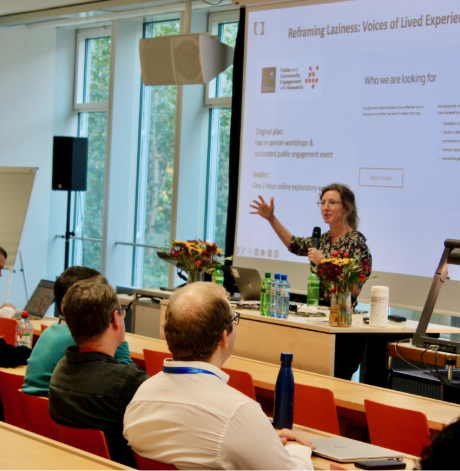
Alt-txt: Professor Katrien Devolder, lead of Project Lazy, speaks to an audience at the front of a lecture theatre. A large screen behind her displays the presentation title, Reframing Laziness: Voices of Lived Experiences.
Caption: Professor Katrien Devolder, lead of Project Lazy, delivering a keynote lecture at the European Association of Centres of Medical Ethics (EACME) Conference in September 2025.
Participants’ call for ‘support, not blame’ and ‘changing systems, not individuals’ informed the argument that academia has an obligation to support ‘slow’ researchers whose work requires time and deep reflection, rather than ‘simply’ expecting them to speed up at the detriment of research, and communities’ welfare.
Read the full blog to discover the key themes, participant insights and reflections from the workshop.
_________________________________________________________

Project Lazy invites everyone to contribute their insights and experiences as the project develops. You can find more information on the Project Lazy website, subscribe to the newsletter and follow them on Instagram to receive updates.