
by Alberto Giubilini, Deputy Director of Education, Uehiro Oxford Institute
You don’t need much moral philosophy to go about your daily life. Arguably, this is not the best way to start a post aimed to promote an MSt in Practical Ethics. Yet, many good people know well what it means to live properly without having ever read moral philosophy. For that matter, many of those well read in moral philosophy are not the most ethical people you will encounter in your life (Schwitzgebel 2009).
When asked what the secret was of his long life, 107-year-old Owen Filer, the oldest man in Wales, replied “There is no secret. You just live properly”. Most people understood what he meant. And those who didn’t are unlikely to learn it in a course in Practical Ethics. Common sense and received wisdom do a good job in helping us navigate common life. And if we are lucky enough, most of our life is rather common. We look after our family, we are nice to our friends, feed our cat, help strangers in need when we encounter them, pay our taxes, behave professionally in the workplace. We all know these are the good things of a life lived properly. You can come up with a theory or a definition if you want, but no theory or definition would tell you much that you don’t already know.
So why study Practical Ethics? Because amidst all this all-too-common life, uncommon circumstances happen, sooner or later. In fact, uncommon circumstances are very common. This a contradiction only in appearance, not in the substance. All common circumstances are alike, but each uncommon circumstance is uncommon in its own way (semi-cit). The type of critical thinking we need in uncommon circumstances can be very different for different types of cases.
For example, if you are a doctor, you commonly give your patient the medications they need and want, by respecting their informed consent and acting in their best interest. This is all good and proper. Except that occasionally a patient will not want any more medicines and would ask you help in being let go. But two requests for assisted dying by two different patients are not the same, their reasons are not the same, their circumstances are not the same. Professional principles and personal values of patients and doctors can start to conflict in very complex ways. Common sense is no longer of much help because there is very little that is common here. Understanding what factors are morally relevant now requires some proper thinking. We need to think at some different, more fundamental level.
As some philosophers would put it, we need to switch from automatic to manual mode and think critically about the reasons and principles behind our moral common sense. For instance, we need to ask whether there is a reason or principle that can explain what it means to live ‘properly’, whether we are prepared to apply that reason or that principle to the uncommon case, or whether we would need to rethink it.
This is where practical ethics becomes important. In our ordinary life, we live up to moral rules we are not aware of because, strictly speaking, we don’t ‘follow’ rules. We don’t even know what the rules are as we simply know what the right thing to do is. Practical ethics allows to understand the underlying rules, principles, moral theories that inform or should inform our moral life when our common sense stops being a solid guide. In a world characterized by the exponential growth of technologies like AI, biomedicine, genetics, the increased capacity for global action and the unwillingness to take it, this is likely to happen more and more often and to happen in many different ways. Two decisions to trust AI’s judgement are not the same, genetic screening for different types of diseases is not the same, and so on. Some such differences matter morally and some don’t. Indeed, many professions involve the systematic handling of uncommon circumstances. It is no coincidence that policy makers, professionals in the AI sector, entrepreneurs, are among the regular students of our MSt in Practical Ethics.
But you don’t need to be one of these stakeholders to benefit from our course. Indeed, our course will offer a way into better understanding the complex and increasingly fragile work we inhabit to all those who are intellectually curious and open to challenging and being challenged by arguments. In democratic societies and in a context of polarised moral and political disagreement, better understanding ethics matters or should matter to everyone, regardless of personal and professional circumstances. Practical ethics will not necessarily give you the answers to all the dilemmas of the uncommon situations we are going to face. But it will help you understand why it is that people disagree, what the nature of that disagreement is, what underlying ethical theories and ethical perspectives are at play. It might not solve the disagreement, but by allowing us to understand its roots, it might help us disagree better. More constructively, perhaps, and in ways that could make mediation and compromises more likely.
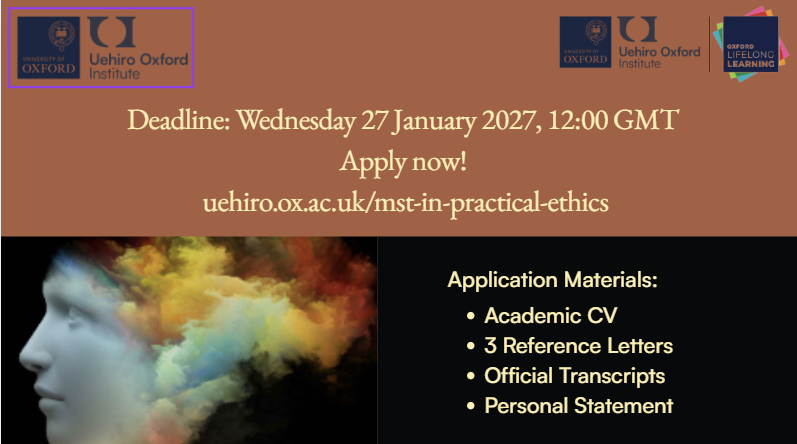
Our MSt blends foundational philosophical teaching around principles, concepts, and theories with practical reflection on themes as different as biotechnologies, disability, human enhancement, wellbeing, psychiatry, artificial intelligence, scientific research, and much more. It will equip students with the tools and skill to navigate the moral complexities of our technologically complex world, dismantling the boundaries of what, when it comes to morality, is a largely artificial distinction between theory and practice.