
-
Neuroblame?
Written by Stephen Rainey Brain-machine interfaces (BMIs), or brain-computer interfaces (BCIs), are technologies controlled directly by the brain. They are increasingly well known in terms of therapeutic contexts. We have probably all seen the remarkable advances in prosthetic limbs that can be controlled directly by the brain. Brain-controlled legs, arms, and hands allow natural-like mobility…
-
Cross Post: In Defense of Offense
Written by Michael Robillard In Defense of Offense “The urge to censor is greatest where debate is most disquieting and orthodoxy most entrenched…” –Chief Judge Alex Kozinski In September of last year, conservative speaker, Ben Shapiro, spoke at the UC Berkeley campus for approximately 90 minutes. The cost of security for the physical protection…
-
Cross Post: The Discomforts of Being a Utilitarian
Written by Hazen Zohny * Please note that this essay was originally published in Quillette Magazine. The Discomforts of Being a Utilitarian I recently answered the nine questions that make up The Oxford Utilitarianism Scale. My result: “You are very utilitarian! You might be Peter Singer.” This provoked a complacent smile followed by a quick…
-
Medical Treatment Disputes and the International Second Opinion
By Dominic Wilkinson @Neonatalethics Disputes about medical treatment for seriously ill children are in the news again. Last week, the High Court in London decided in favour of withdrawal of life support from a brain damaged 11-month old infant, Isaiah Haastrup, against the wishes of his parents (an appeal is pending later this month).…
-
The ‘Killer Robots’ Are Us
Written by Dr Michael Robillard In a recent New York Times article Dr Michael Robillard writes: “At a meeting of the United Nations Convention on Conventional Weapons in Geneva in November, a group of experts gathered to discuss the military, legal and ethical dimensions of emerging weapons technologies. Among the views voiced at the convention…
-
The Disunity of Utilitarian Psychology: Runaway Trolleys vs. Distant Strangers
Guy Kahane**, Jim A.C. Everett**, Brian D. Earp, Lucius Caviola, Nadira Faber, Molly Crockett, and Julian Savulescu Last week, we invited people to find out “How Utilitarian Are You?” by filling out our newly published Oxford Utilitarianism Scale. The scale was widely shared – even by Peter Singer (who scored predictably highly). The Oxford Utilitarianism…
-
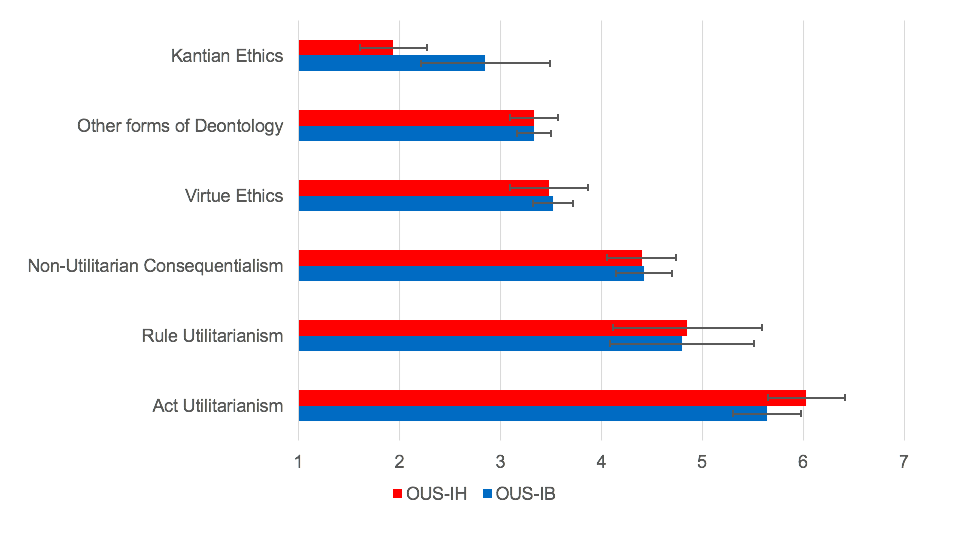
How Utilitarian Are You? Measure on The Oxford Utilitarianism Scale
Blog Authors: Julian Savulescu, Brian D. Earp, Jim A.C. Everett, Nadira Faber, and Guy Kahane This blog reports on the paper, Kahane G, Everett J, Earp BD, Caviola L, Faber N, Crockett MJ, Savulescu J, Beyond Sacrificial Harm: A Two Dimensional Model of Utilitarian Decision-Making, Psychological Review [open access] How Utilitarian are you? Answer these 9…
-
Cross Post: Think Twice Before Sending Facebook Your Nude Photos: The Shadow Brokers’ Disclosures Prove Privacy and Security Are Not a Zero-Sum Game
Written by Dr Carissa Veliz This article first appeared in El Pais Time and again, we have been sold the story that we need to give up privacy in exchange for security. According to former NSA security consultant Ed Giorgio, ‘Privacy and security are a zero-sum game’—meaning that for every increase in one,…
-
New Year’s Reflection
written by Neil Levy It’s the time of year at which many of us take stock of how our lives are going. It is more or less arbitrary where we mark the end of the year, but because the convention is shared, our lives have a rhythm that is marked by the calendar, and the…